







Recent Public Posts - [guest]
| Re: Checking on your train running just before you set off In "Introductions and chat" [379986/32503/1] Posted by Chris from Nailsea at 21:31, 24th September 2026 |      |
I'm rather inclined to ask grahame, perhaps somewhat cheekily, whether he could please add 'Nailsea & Backwell' to the Coffee Shop forum links to Tiger in 'Next departures' at head of this page.
CfN.


| Re: Greenways - Uckfield to Lewes differences of view looking forward and wider In "The Wider Picture in the United Kingdom" [379982/32534/51] Posted by Chris from Nailsea at 20:53, 24th September 2026 Already liked by Richard Fairhurst | |
There is a lot on the forum that is what I think of as the far west which passes me by.
Anything going beyond Yatton passes me by.
Oh, I see what you mean.

| Reported assaults on Britain's rail services rise by more than a third In "The Wider Picture in the United Kingdom" [379979/32536/51] Posted by Chris from Nailsea at 20:39, 24th September 2026 | |
Some sombre reading here for members of the Coffee Shop forum and our guests.
From the BBC:
Reported assaults on Britain's rail services rise by more than a third
Reports of violent incidents and harassment on rail services "rose substantially" last year, figures from the rail regulator show.
Reported assaults, including physical and verbal, were up 36% in the year to March 2026 compared with the previous year, according to the Office of Rail and Road (ORR).
In total 13,464 assaults against passengers and members of the public were recorded on Britain's mainline railway, the highest number recorded since the series began in 2004.
The ORR said the figures were "concerning" and that it was working with the industry to address the problem.
According to the figures, harassment increased by 52% compared with the previous year and common assaults rose by 30%. The increase comes against a backdrop of five years of rising reports of incidents and industry campaigns to raise awareness.
Assaults on the mainline railway are recorded according to their type. As a result each incident can lead to reports in more than one category, for example if someone is harassed and then physically assaulted.
There were also 11,289 reported assaults against members of the workforce on the mainline railway, up 12% compared with the previous year. Of those 2,487 were physical assaults, while more than half (6,390 incidents) involved verbal abuse. The rest were threats.
"We're working with industry and our trade union colleagues to address work-related violence and harassment," said Richard Hines, the ORR's chief inspector of railways. "This includes understanding where the risks are, putting effective controls in place, encouraging staff to report incidents and providing appropriate support afterwards," he said.
The statistics include mainline rail services in England, Scotland and Wales, but not Northern Ireland. The data release also covers the London Underground, trams, metros and other light rail services.
On the London Underground, recorded assaults increased 20% to 5,534 in the latest year, but reported workforce assaults fell 3% to 3,525.
Transport for London does not record multiple aspects of each incident. Instead it records the most severe aspect reported.
A spokesperson responding on behalf of Network Rail and the train companies said all operators were working to reduce risk and prevent harm by sharing information, improving reporting processes and deploying body-worn cameras.
"Keeping passengers and colleagues safe is at the heart of everything we do," the spokesperson said. "Violence, abuse and intimidation directed at passengers or staff are completely unacceptable. The rail industry works closely with British Transport Police to investigate incidents, support victims and bring offenders to justice."
The passenger body, Transport Focus, said the ORR's figures supported research it conducted which found personal security was "one of the highest priorities" for passengers. However, only 3% of passengers it surveyed said they were dissatisfied with personal safety at the station.
Transport Focus acknowledged that some of the increase might reflect better reporting. Nevertheless, every incident represented someone negatively affected, it said, adding it would like to see "a much more strategic approach" to tackling the issue.
The RMT union, representing rail industry workers, said the figures corresponded with the union's own figures indicating two-thirds of its members had experienced violence at work.
RMT general secretary Eddie Dempsey called for an increase in staffing on public transport, including an end to lone working, to combat the problem. "We also clearly need stronger legal protections for public transport workers against assaults at work," he said.
He said cuts to British Transport Police funding had been "disastrous" and called for outsourced security and enforcement staff to be brought in-house "as a matter of urgency".
Other notable figures from the statistical release include that 11 members of the public died at mainline level crossings in the latest year, six more than the previous year. Eight were pedestrians and the others were road vehicle users.
Reports of violent incidents and harassment on rail services "rose substantially" last year, figures from the rail regulator show.
Reported assaults, including physical and verbal, were up 36% in the year to March 2026 compared with the previous year, according to the Office of Rail and Road (ORR).
In total 13,464 assaults against passengers and members of the public were recorded on Britain's mainline railway, the highest number recorded since the series began in 2004.
The ORR said the figures were "concerning" and that it was working with the industry to address the problem.
According to the figures, harassment increased by 52% compared with the previous year and common assaults rose by 30%. The increase comes against a backdrop of five years of rising reports of incidents and industry campaigns to raise awareness.
Assaults on the mainline railway are recorded according to their type. As a result each incident can lead to reports in more than one category, for example if someone is harassed and then physically assaulted.
There were also 11,289 reported assaults against members of the workforce on the mainline railway, up 12% compared with the previous year. Of those 2,487 were physical assaults, while more than half (6,390 incidents) involved verbal abuse. The rest were threats.
"We're working with industry and our trade union colleagues to address work-related violence and harassment," said Richard Hines, the ORR's chief inspector of railways. "This includes understanding where the risks are, putting effective controls in place, encouraging staff to report incidents and providing appropriate support afterwards," he said.
The statistics include mainline rail services in England, Scotland and Wales, but not Northern Ireland. The data release also covers the London Underground, trams, metros and other light rail services.
On the London Underground, recorded assaults increased 20% to 5,534 in the latest year, but reported workforce assaults fell 3% to 3,525.
Transport for London does not record multiple aspects of each incident. Instead it records the most severe aspect reported.
A spokesperson responding on behalf of Network Rail and the train companies said all operators were working to reduce risk and prevent harm by sharing information, improving reporting processes and deploying body-worn cameras.
"Keeping passengers and colleagues safe is at the heart of everything we do," the spokesperson said. "Violence, abuse and intimidation directed at passengers or staff are completely unacceptable. The rail industry works closely with British Transport Police to investigate incidents, support victims and bring offenders to justice."
The passenger body, Transport Focus, said the ORR's figures supported research it conducted which found personal security was "one of the highest priorities" for passengers. However, only 3% of passengers it surveyed said they were dissatisfied with personal safety at the station.
Transport Focus acknowledged that some of the increase might reflect better reporting. Nevertheless, every incident represented someone negatively affected, it said, adding it would like to see "a much more strategic approach" to tackling the issue.
The RMT union, representing rail industry workers, said the figures corresponded with the union's own figures indicating two-thirds of its members had experienced violence at work.
RMT general secretary Eddie Dempsey called for an increase in staffing on public transport, including an end to lone working, to combat the problem. "We also clearly need stronger legal protections for public transport workers against assaults at work," he said.
He said cuts to British Transport Police funding had been "disastrous" and called for outsourced security and enforcement staff to be brought in-house "as a matter of urgency".
Other notable figures from the statistical release include that 11 members of the public died at mainline level crossings in the latest year, six more than the previous year. Eight were pedestrians and the others were road vehicle users.
My highlighting. Chris from Nailsea.

| Re: To 'stockpile food' is now our Government's official policy, apparently In "The West - but NOT trains in the West" [379978/32456/31] Posted by broadgage at 19:02, 24th September 2026 Already liked by johnneyw | |
This report https://www.bbc.co.uk/news/articles/cmp30r1klk37o?at_medium=RSS&at_campaign=rss
Suggests that russia is already waging a hybrid war on the west, and that one should be prepared not only for extreme weather, but also for disruption to food and fuel supplies.
| Re: Greenways - Uckfield to Lewes differences of view looking forward and wider In "The Wider Picture in the United Kingdom" [379975/32534/51] Posted by CyclingSid at 15:45, 24th September 2026 | |
Thank you eightonedee for the clarification. Problem is one assumes others have a similar view of the world. There is a lot on the forum that is what I think of as the far west which passes me by.
| Re: Checking on your train running just before you set off In "Introductions and chat" [379974/32503/1] Posted by JohnM at 15:36, 24th September 2026 | |
Which sources do you use?
National Rail phone app, My Travel/My Favourite Journeys/Live Trains searches. My Melksham-Bristol commute requires 2 trains, and live trains for the connecting station (usually Trowbridge out, Chippenham return) shows both. Seems to be pretty reliable.Ha - of course I've just opened the app and it's completely frozen. Don't remember ever seeing that before.
| Re: Greenways - Uckfield to Lewes differences of view looking forward and wider In "The Wider Picture in the United Kingdom" [379973/32534/51] Posted by Mark A at 15:00, 24th September 2026 | |
Ah - thanks.
Mark
| Interral pass sale - buy until the end of September for use by August 2027 In "Fare's Fair" [379972/32535/4] Posted by grahame at 14:39, 24th September 2026 Already liked by Mark A | |
Well - that has let a goat into the garden (*)! Interrail have announced a sale on international train rover tickets buy by the end of this month, and save anything up to 50% on the normal price which is (for Lisa and me and our use anyway) already good value.
Purchase by the end of September, for activation within 11 months later (so by end of August 2027).
Interrail Global Pass, promotion prices
Example - 4 days within 1 month, 2nd class - £209.00 (Adult), £188.00 (Senior)
Travel on as many trains as you like on each of your 4 travel days – perfect for visiting 3-5 destinations.
Example - 3 months, continuous, 1st class - £540.00 (Adult), £485.00 (Senior)
Travel on as many trains as you like on each of 90 days.
* Covers most trains in 33 countries.
* Just 2 days to / from / within your own country - "outbound" and "inbound"
* You can use your travel days any time within 1 month of your start date.
* Seat reservations may be required for some trains, at an extra cost.
* One Pass. No fixed route.
* Take the long way around Europe, with up to 11 months to begin your trip.
* Promo Passes are 100% refundable or exchangeable within 7 days (0% after).
Small print -
* does NOT include mandatory reservations (nor optional ones), sleeper train and other surcharges where they are needed. Most of Europe can be covered without / very limited in Spain and somewhat limited in France, and on many tourist and heritage lines. * Does not include local metros and tram networks, nor buses - but there are some reductions on some ferries.
* Does not include long distance coaches nor airline flights if you use them
* Does not include travel insurance, nor board, lodgings, entry to museums, and other things you do / use while away
* Does not include costs of roaming on your phone, or internet connections unless free on trains
* Does not include cost of kennels for pets, dog, cat, budgie and house sitters
* Does not include cost of gifts you bring back for loved ones, family, colleagues and friends
In other words, the pass is likely to be only a small part of your outlay.
Web site - https://www.interrail.com/en . I am NOT normally someone who rushes to buy in a sale, and especially one with cancellation terms like these. However, to me this is not a normal sale - it's a product I have bought in the past, know well, and will be buying again in the next few days. And, no, I get no commission ;-)
(*) The idiom:
Russian - Let a goat into the garden
Dutch - Throwing the bat into the chicken shed.
French - Throwing a cobblestone into the pond
Spanish - To disturb the dovcote
English - Put the cat amongst the pidgeons
In colonial India, a popular pastime was to put a wild cat in a pen with pigeons. Bets would be made on how many birds the cat would bring down with one paw-swipe. The period of the British colonisation of India may have introduced this concept, and hence the phrase to the English language.
| Re: Greenways - Uckfield to Lewes differences of view looking forward and wider In "The Wider Picture in the United Kingdom" [379971/32534/51] Posted by eightonedee at 14:26, 24th September 2026 Already liked by Mark A | |
Talk of a 'Third river crossing' is a bit mystifying
Not if you live in Reading, Mark!
The problem is that there only two road crossings of the Thames in Reading, Reading and Caversham bridges, and that's been the case since 1923, notwithstanding the exponential increase in road traffic, and that Caversham (the part of the town north of the Thames, the rest being on the south side) has grown enormously as a largely residential suburb of the town, with precisely zero increase in road capacity. Not only Caversham residents use it to get to Reading , but also those in the peripheral villages in an arc north of the river which are satellite settlements of the town too. Some of these (notably Sonning Common and Woodcote) have also grown in population substantially. Even the town of Henley-on-Thames, 8 miles distant, is substantially a posh suburb or Reading (not that they like to think of themselves in these terms). Should the residents of these towns and villages want to travel by road to get to the M4, or catch a train to London, they also have to cross these bridges and struggle through Reading's traffic, although to the west they can cross using the quaint toll-bridge at Whitchurch to get to Pangbourne (itself a traffic bottleneck) to get to the station there or M4 junction 12, or (to get to Twyford station or the M4 east/A329(M) south) take Playhatch Road (a narrow road running around the east side of Caversham) to Sonning via two more quaint narrow bridges, then get slowly through Sonning's narrow streets and resulting traffic jams. To add to this overload, the A4074, one of the two grossly inadequate more direct routes between Reading and Oxford, runs via Caversham, feeding more traffic onto these bridges.
A long time ago, between 1973 and 1975, a motorway was opened linking Reading, the M4 and Bracknell with provision for it to be extended northwards to cross the Thames east of the town, linking up to the A4155 main road to Henley, designed by Berkshire County Council (who built it) to give the opportunity to take the through traffic out of Lower Caversham and a route avoiding the Sonning and Whitchurch/Pangbourne crossings, a long-standing policy objective. The problem is that as a result of the bungled 1972-4 local government reorganisation, the northern end of this bridge and route still lay in Oxfordshire, even though most of the land can actually only be reached from Berkshire/unitary Reading. Notwithstanding that the land affected is largely disused mineral workings, and some of the principal beneficiaries of the scheme would have been Oxfordshire's own residents in Henley and the aforementioned northern peripheral villages, Oxfordshire (and South Oxfordshire, as planning authority) has consistently opposed this bridge, over which they hold an effective veto.
So Sid is not quite right - it's now over 50 years that the Third Bridge has been blocked!
So I can't say I see any "Thames Valley" mayorality being likely to help, unless it is set upon the basis that it must support the Third Bridge (that pig will not fly..).
| Re: Checking on your train running just before you set off In "Introductions and chat" [379969/32503/1] Posted by johnneyw at 13:36, 24th September 2026 Already liked by Chris from Nailsea | |
Which sources do you use?
I'll often check Tiger on the day of departure or, especially for a day out, before my return leg just to see if I need to make any appropriate adjustments to my plans. No point in rushing from that agreeable hostelry at the end of a long day out if the train is significantly delayed after all!
Biggest problem with Tiger is the time taken to update new stations. Ashley Down, for example, is not yet included.
| Re: Greenways - Uckfield to Lewes differences of view looking forward and wider In "The Wider Picture in the United Kingdom" [379968/32534/51] Posted by Mark A at 13:29, 24th September 2026 | |
More talk of a third river crossing, which I have heard for the last 30 or 40 years, it will only happen if you eliminate South Oxfordshire council or its equivalent, and probably change the method of property taxation.
Talk of a 'Third river crossing' is a bit mystifying.
| Re: Greenways - Uckfield to Lewes differences of view looking forward and wider In "The Wider Picture in the United Kingdom" [379967/32534/51] Posted by Mark A at 13:13, 24th September 2026 Already liked by Richard Fairhurst, Witham Bobby | |
It has to be said that aside from the more or less vanished last few miles into Bath, the Bristol to Bath trackbed was the recipient of one deliberate obstruction - that housing development at Kingswood Junction, positioned to obfuscate both the Bristol Bath alignment and the route to Avonmouth. (The planners overcooked things a bit as the development puts such a kink into the B to B path that the bend emerged as a safety issue and had further work to mitigate the risk.)
The Borders Railway... brought the Glenesk viaduct back into use as a railway structure, but as a result the high-quality-in-terms-of-levels cycle/walking route across the viaduct was lost and there was a view that the Borders Railway could have compensated the paths network people who'd spent a considerable amount of cash on the structure to bring it into good condition but then lost the use of it. (As an aside, photos of the viaduct from its Waverley Railway days seem to be non-existent - apparently the deck of the structure, built at an early date for a single track and more primitive colliery line was just wide enough for standard gauge double track - albeit with cantilevered walkways alongside).
| Re: Bombs, Bridge Strikes, Fires and Gas Main leaks In "Across the West" [379966/32530/26] Posted by eightonedee at 12:51, 24th September 2026 Already liked by Witham Bobby | |
By the simple expedient of installing reinforced concrete ducts, with secure but removal tops which double up as the the footways. Whatever services use the ducting, be it pipes or cables, are securely fixed to the insides of the box.
This is a common practice when building substantial housing estates (and has been for at least a couple of decades), albeit the ducting is usually buried with access points. But it is easy to ensure that this is done if you are building a green field site so you can get it right from the start, and the highway authority can require service margins and ducting as part of the adoption specification. The problem we have is that we have 150 years of underground services laid under roads that had no service margins as each service supply was laid, often with inadequate paper plans being kept/preserved as local government and service undertakers were repeatedly reorganised or merged. These run along roads that are bounded on either side by existing buildings or private land.
Goodness knows how much it would cost (and how much disruption it would cause) to lay new ducted services along our roads or beside them if there's space.
| Re: Greenways - Uckfield to Lewes differences of view looking forward and wider In "The Wider Picture in the United Kingdom" [379964/32534/51] Posted by CyclingSid at 12:26, 24th September 2026 | |
And in today's news https://www.bbc.co.uk/news/articles/cq0kly30e7n2o "A better journey with a Thames Valley mayor?" A major difficulty appears to be in deciding what is the Thames Valley. In my previous work they used to say the six unitaries in Berkshire were "like trying to herd tigers" (they were only cats in the days of the county council).
I am not saying there isn't a lot of sense in what is being said but
"We need to make it a little bit more inconvenient to drive, and more joyous and easy to walk, cycle, get the bus, use the train to encourage people to make the active travel choice."
is possibly not the way to get the voters on board.More talk of a third river crossing, which I have heard for the last 30 or 40 years, it will only happen if you eliminate South Oxfordshire council or its equivalent, and probably change the method of property taxation.
| Re: Greenways - Uckfield to Lewes differences of view looking forward and wider In "The Wider Picture in the United Kingdom" [379961/32534/51] Posted by Richard Fairhurst at 10:57, 24th September 2026 | |
There are several examples of greenways on redundant trackbeds subsequently being reopened as railways - the Borders Railway and Airdrie–Bathgate on the mainline railway, the Welsh Highland as a preserved line, no doubt more I haven't remembered.
When the BML2 chap says "it will eradicate all chances of the railway ever re-opening" I would very fervently disagree. Building a greenway preserves the continuous trackbed for potential later reuse - canal restorers have known this for years. Would the Bristol-Bath trackbed still be uninterrupted if there wasn't a path along it? Or the Camel Trail from Wadebridge to Padstow? I doubt it.
You can very easily move the path to the side of the trackbed as and when you're ready to open a railway - that's what happened on the Borders, Airdrie–Bathgate and the Welsh Highland. Walkers and cyclists have less demanding geometry requirements than trains!
| Re: Disused rail viaduct over the Spey at Garmouth fails In "Railway History and related topics" [379960/31260/55] Posted by JohnM at 10:55, 24th September 2026 | |
National Lottery grant?
| Re: Disused rail viaduct over the Spey at Garmouth fails In "Railway History and related topics" [379959/31260/55] Posted by Mark A at 10:34, 24th September 2026 | |
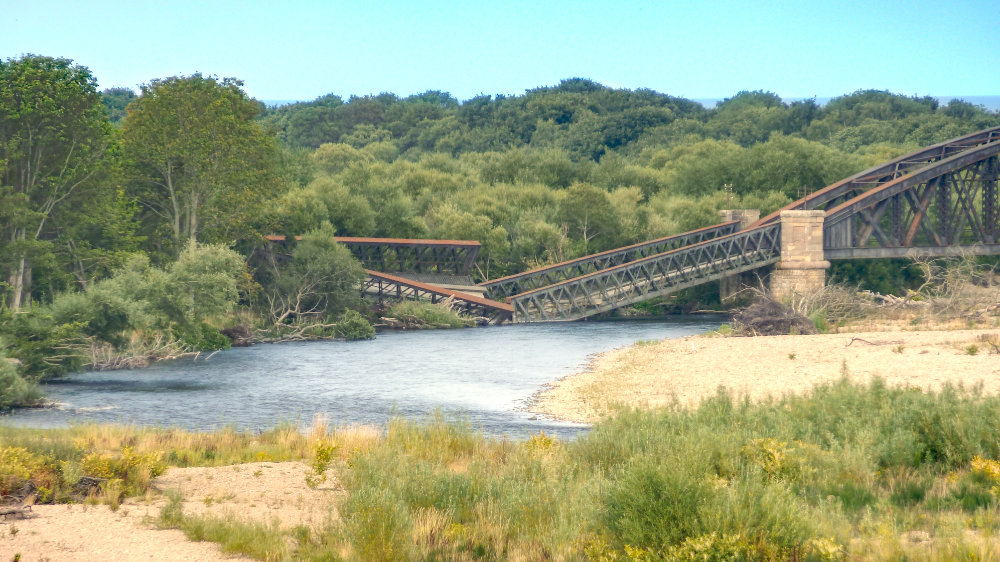
Paying Garmouth viaduct three visits earlier in September, and other things aside, the sight of an ambitious bridge in a state of failure was moving and disturbing in equal measure. Talking with a local walker of dogs, a friend very nearly witnessed the collapse the hard way: that morning, on a brief early morning dog walk. they crossed the structure west to east and then found themselves stranded on the wrong side and with an eight mile walk to get home. Possessed of a dry sense of humour, the observation from them was to the effect 'Well it was there at 8:30am'.
The long distance path brings visitors from overseas (it's NCN1 and itself a component of an international coastal route) and in Garmouth, long distance touring cycle people were much in evidence, having made the detour and then rejoined the route. For good measure the road bridge some miles upstream has long term road works on it as the bridge deck is being sealed and resurfaced and for much of the day there's a long queue of vehicles into a contraflow. More than one of the long distance tourers had not heard of the bridge collapse so the closed route had come as a suprise to them, as it had to a rather tidy elderly touring cyclist from the west midlands, well kitted out but brought to an abrupt stand. He hadn't heard of the cafe in the village either, mind, and was pleased to discover it.
The bridge though, the two fallen spans still lie where they fell, one horribly wrung and the other fairly intact but in the 21st century, not reuseable. One failed pier is beneath the waters, its downstream companion leans heavily. As yet, the debris in the channel has not prompted much change in the Spey's braided streams, but with a winter flood that the situation is likely to evolve.
Moray council has applied for and received planning permission to remove the two spans from the river, but the tenders for that contract have so far come in at an unacceptable price, and as yet, they rest where they fell.
Image, please, Postimages:
| Re: Checking on your train running just before you set off In "Introductions and chat" [379958/32503/1] Posted by PhilWakely at 10:25, 24th September 2026 Already liked by Witham Bobby | |
If you are one of those travellers who purchase their tickets online for a specific train and get an email advising you your train has been cancelled..... do you double-check or do you believe that email?
Customers in Devon are told by tr@!nl!n3 that their Penzance to <wherever> train has been cancelled. They turn up at the station expecting to catch the next train, only to find that their train ran - starting from Plymouth! No entitlement for compensation and Advance ticket holders have to pay again! I've seen this happen many times!
